Storm Damage Tree Removal in Greenville, SC
The Trees That Fell, and the Ones That Only Look Fine
Storm damage tree removal in Greenville, SC is about more than the tree on the ground, which is where every eye goes the morning after. The ones worth worrying about are still standing: cracked at a fork, leaning more than last week, holding a broken limb forty feet up. This guide sorts them into the jobs that can't wait, the ones to schedule, and the trees that only need a good prune.
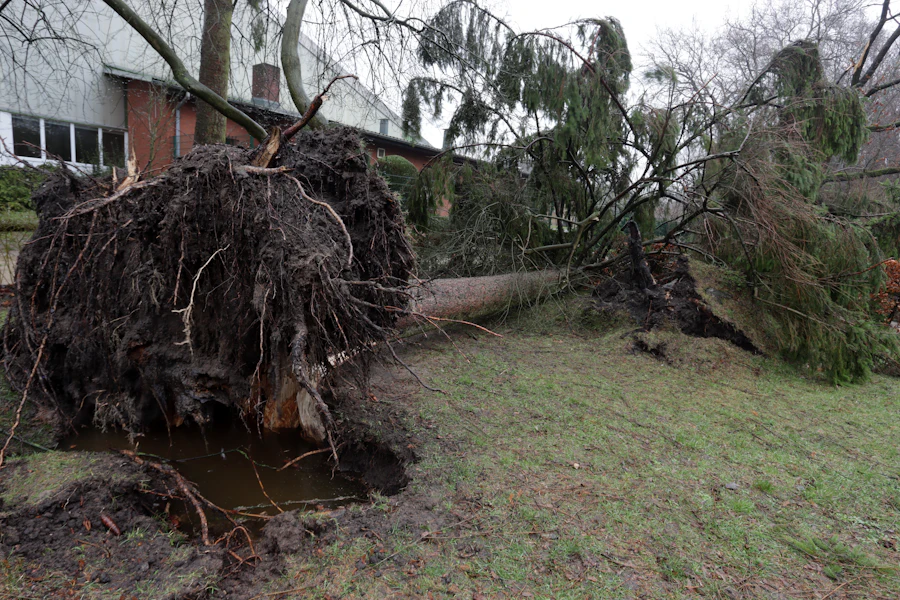
The tree on the ground is the easy one
A fallen tree is a cleanup job with a known ending. On the house, the garage or a fence, it goes to the front of every crew's list in the county, and the homeowner's policy generally covers getting it off the structure, minus the deductible — the emergency page walks through those first hours. In the open, hitting nothing, it is neither an emergency nor a claim: it gets quoted on a normal day, at normal prices.
Reading the trees that stayed up
Once the wind has quit and any downed lines are confirmed clear, look at each big tree from two sides. Storm damage falls into a short list of patterns:
| The damage | What it means | The call |
|---|---|---|
| A broken limb caught in the canopy — a hanger | It hasn't finished falling, and it hasn't chosen when | Down now; an emergency if it hangs over anywhere people walk |
| A fresh split where two big stems meet | Bark squeezed between the stems gave way — the failure point in many storm breakups | Removal, most of the time; cabling only on a tree worth the gamble |
| A new lean, or soil bulged on one side of the trunk | The root plate moved in waterlogged clay, and the tree is still moving | Removal this week — not next winter |
| Big limbs torn off one side, crown lopsided | Open wounds, and a sail that now catches wind unevenly | Prune and watch if most of the crown is intact; remove if the tree is mostly wound |
| The top snapped out of a pine | A stressed pine calls in every beetle in the neighborhood | Remove within the season, before it dies standing and turns brittle |
| A Bradford pear split down the middle | The species does this on schedule; it was always going to | Remove — there is no repair for the way it is built |
Why the leaner scares us more than the faller
Greenville's storm-failure recipe is tall loblolly pines on red clay that has been soaked for days: the clay loses its grip on the root plate and the whole tree hinges over, roots and all. A pine that hinged partway and stopped is still on that path — the ground bulging on one side of the trunk means it is moving, and the next ordinary thunderstorm finishes what the big one started. Helene, in September 2024, put thousands of Upstate trees down in a single night, and its lesson holds the week after any storm: a tree that has shifted gets dealt with before it is in the living room, not after.
What storm damage removal costs, and why one tree can price two ways
The same tree carries two prices depending on when it comes down. On the storm's own timeline — on a roof, across a driveway, at night, with a crane — it sits in the hazard and over-structure band, $2,500–$6,000 and up, because it comes apart piece by piece with every load roped and lowered. Read on a normal day and taken down on a normal schedule, a storm-damaged tree prices like any other removal: a large mature oak or pine runs $1,200–$3,000 and up, and the size ranges behind that number are laid out for a scheduled tree removal in Greenville after the storm. Dead or brittle wood, which a climber cannot trust to hold rigging, and anything the tree overhangs push it toward the top of either band. That is the whole argument for reading the standing trees early: a leaner removed this week is a normal bill, while the same tree on the house next month is a deductible, a roof claim and an emergency rate — and insurance almost never pays to remove a standing tree, damaged or not. One more rule for that week: crews with out-of-state plates will knock with a chainsaw and a cash price. Get a written number from a company you called. Line by line, the reasons that storm-timeline band runs so high are broken down in what an emergency tree removal costs and why.
Storm-proofing the trees you're keeping
The trees that fail in a storm are usually the ones already carrying deadwood, an old crack or a lean nobody looked at. The cheap version of storm prep is crown thinning and deadwooding — cuts that let wind pass through a big oak instead of pushing on it like a sail. The next-cheapest is booking the hazard removal you already know about for winter, when crews are between storm cycles and pricing is at its friendliest; the cost guide explains why December through February is the window.
Storm damage questions
Is a tree that's leaning after a storm an emergency?
Will insurance pay to remove a tree the storm damaged but didn't drop?
Can a storm-damaged tree be saved instead of removed?
Storm-hit tree still standing? Get it read before the next line comes through.
Send the address and a photo from two sides with your request, and the local tree company it goes to will say remove, prune or wait, and what it costs.
Call (864) 501-0549